Friday, August 26, 2011

Great Bear Rainforest Day 1-2


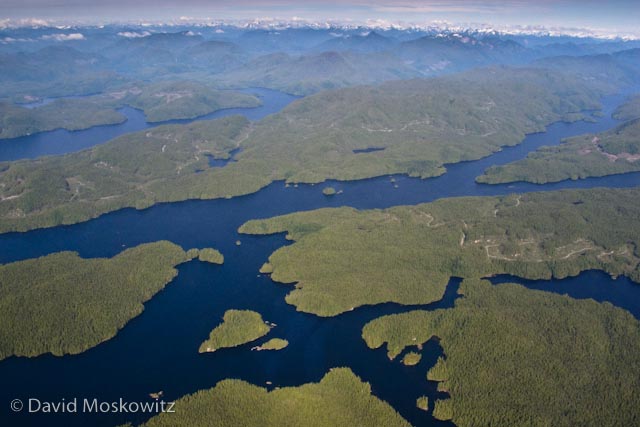
View from the flight into Bella Bella-a maze of rainforest clad islands
and wandering ocean inlets bounded by the Coast Range to the east
View from the water on my first day out in the field.

Doug Brown, the field station manager for Raincoast Conservation Foundation,
and my guide, spotted this wolf along the shore of a small island northeast of Bella Bella

Sunshine and wolves greeted me on my first day in the field here on the central coast of British Columbia. The salmon are gathering at the mouths of the creeks and rivers here.

Learn more about my current project on Wolves in the Pacific Northwest!

Friday, August 12, 2011

Wolves of the Pacific Northwest


Contact David at moskowitz_david@hotmail.com to support his project! 


WOLVES IN THE LAND OF SALMON 
A unique and fascinating story is waiting to be told about one of the world’s most intriguing animals and its place in the diverse and striking landscapes of the Pacific Northwest; from wild coastlines and rainforests to remote mountain ranges and inhospitable deserts.
  • How do wolves survive in a temperate rainforest and how is this different from their behavior and ecology in the harsh high deserts east of the Cascades and BC Coast Range?
  • What have been the impacts of over a century of wolf extirpation from Western Washington and Oregon?
  • What are the prospects and ecological significance of their recovery across Oregon, Washington and Northern California?
  • What is the cultural significance of this iconic predator for indigenous peoples of the region and for modern western culture in the Northwest?
Answers questions such as these, and inspiring appreciation and conservation of our region’s wildlife and wildlands are at the heart of Wolves of the Pacific Northwest, a book I have a contract to write and photograph (Timber Press, Portland, Oregon). Lyrically written and strikingly photographed, while also academically rigorous and original, this book is designed for a broad audience. 


THE FUTURE OF WOLVES IN THE PACIFIC NORTHWEST
The wolf is an icon of the wild, and a critical element of many of the ecosystems it inhabits. The story of wolves living in the Pacific Northwest is unique and provides a new lens to explore the ecology of a well known species, one often associated with the wide open tundra or vast grasslands rather than dense old growth forests, wild coastlines, mountainous landscapes, or deserts. As wolves become an increasingly conspicuous element in wildlands of our region and capture headlines in the news, people’s interest and curiosity about this regal symbol of the wild will also grow.
The re-establishment of wolves is now underway in the southern Pacific Northwest, making this project both a timely and time-sensitive one. With state and federal managers actively working on preparing for a rapid increase in the numbers and associated issues of wolves in the region, interest from the general public will only be growing in the near future.

On the wild Central Coast of British Columbia, one the most inaccessible parts of the region, wolves face challenges from increases in industrial resource extraction and declining salmon runs. Vancouver Island, where wolves were once extirpated but naturally re-established themselves has been at the forefront of challenges between wolves and recreation wilderness users, an issue which will also likely be prominent in Washington and Oregon.


NOT JUST A BOOK: A CONSERVATION INITIATIVE
There are few single elements of the natural world more compelling to the human psyche then wolves. Across the globe, and throughout time, wolves have captured the imaginations of humans. Here in the Pacific Northwest, both their recent absence and now reestablishment have brought into sharp focus the interest in this charismatic apex carnivore.
Along with the production of a book, photographs, articles, and presentations from this project will be used to promote awareness and conservation regionally through collaborations with educational and conservation organizations including Conservation Northwest (www.conservationnw.org)  Wilderness Awareness School (www.wildernessawareness.org), and Wildlands Network (www.wildlandsnetwork.org) .


CAPTURING THE STORY
Pulling together the multitude of parts of this complex story will involve extensive literature research, interviews with experts in the field and expeditions across the region to places where wolves have maintained healthy populations, areas where reestablishment of populations in now occurring, and locations were wolf extirpation has had significant impacts on the regional ecology.
All of the writings and other media produced for this project will draw on the latest research findings on wolves and my own first hand encounters in the field with wolves and their environment. Field research and photography expeditions will be carried out via kayak, ski, backpacking and boat trips.


YOUR SUPPORT
 The support of numerous individuals, along with grant funding I am seeking from foundations, and in kind donations, has helped secure equipment needed for field work and photography, defray travel costs, and help underwrite other research and cost of living expenses as I've started this project. However, with many field trips ahead to complete the main manuscript for this project and plan public outreach events I am still actively seeking funding.


If you are interested in supporting this project please send me an email at moskowitz_david@hotmail.com.
Sunday, July 24, 2011

Do mink (Neovison vison) have webbed feet?

While researching and writing my field guide I encountered various published accounts of the foot structure of mink (Neovison vison). Because of these discrepancies I sought out specimens to examine personally. I examined the feet of 3 recently deceased mink, all from western Washington as well as about a dozen museum skins at the Burke Museum at the University of Washington. All of the green specimins I examined showed mesial webbing on both front and hind feet. Some of the museum skins did as well, while others where dried in such a way so as to make analysis of this impossible. None of the green specimins or museum skins were clearly lacking webbing between toes. The amount of webbing is slightly less than in their larger cousins, river otters (Lutra canadensis) but is none the less quite clear. As is typical with the tracks of most web-footed animals, webbing can be detected in footprints in deep substrates but is often not apparent where substrate is firmer.

The photos of actual feet bellow are from a male mink which was killed by a vehicle in the Snoqualmie River Valley, King County, Washington in 2009.

Left front foot.

Left front foot with toes splayed showing mesial webbing between toes.


Hind feet.

Toes splayed on hind foot revealing webbing.

Top view of a hind foot also showing webbing.
All four tracks of a mink in a typical loping pattern for the species. In this deep substrate the webbing between the toes has registered. Tracks from along the Snohomish River, Snohomish County, Washington.

Closer view of two tracks (left hind on top of left front) from the same set of tracks as above.

Tracks a small (likely female) mink from along the Yakima River in Kittatas County, Washington, also in a typical loping pattern. In this firmer substrate the mesial webbing has not registered.

Sunday, June 19, 2011

Clayoquot Sound Revisited

 A week of journeying by land and sea has yielded some great results as I continue to collect material for my forthcoming book on Wolves of the Pacific Northwest. I am tremendously grateful to Steve and Susanne Lawson for their invaluable assistance in my fieldwork here in Clayoquot Sound thus far! Stay tuned for more photos and stories to come!


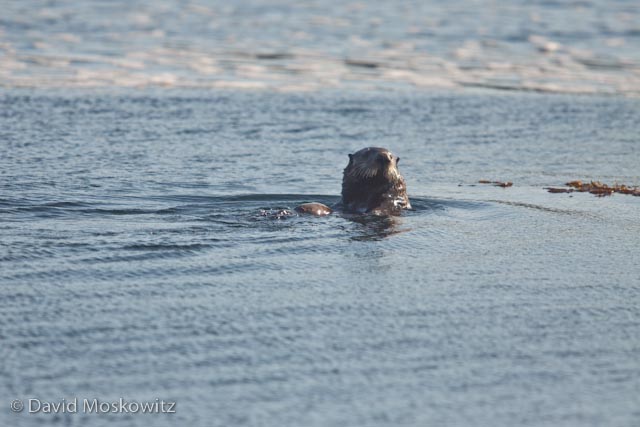
Sea Otter patrolling coastal waters north of Ucluelet.

The return of extensive bull kelp forests along the northern Pacific coast has been associated with rebounding Sea otter populations, a classic example of a trophic cascade. Bull kelp was released from heavy browsing pressure by sea urchins with the return of otters which love to eat urchins.

Rocky coastline close to Wye Point, north of the town of Ucluelet

Guess the beach brings out the playful side of more than just juvenial people. Here two yearling wolves play with washed up seaweed  on an island in Clayoquot Sound.

Wolf crossing a lead of water at first light.

We watched this randy male black bear following a smaller female bear earnestly, stopping only to rub vigorous on a large drift wood log, a behavior which increases during the breeding season.

Oystercatchers are one of the most common shorebirds in the Sound this time of year.

Thursday, March 3, 2011

Freeloading Chicken Update

"Dave-  I checked the White Pine camera on Sunday the 20th after two weeks, got about 640 shots of a Pine Marten, two grey jays, and a few wind triggers.  I replaced the batteries, card, bait and scent.  It only took that Marten two days to get all the bait."--Pete Jenkins

American marten poses after dispatching the freeloading chicken.

Monday, February 7, 2011

The Curious Case of the Freeloading Chicken and the Wolverine

This weekend, following up on several sets of likely wolverine tracks biologist and backcountry skier Pete Jenkins discovered, a small group of intrepid citizen scientists set out to place a remote camera in the vicinity in hopes of capturing a photo of the illusive carnivore. Grey skies and a very thin coat of fresh snow beckoned.

Clouds covered the high peaks of the Chiwakum mountains south of Highway 2 in the Washington Cascades when the group met early Saturday morning. For the project, a few unusual items were called for, not usually included in the field kit of backcountry skiers: a hammer, some chicken wire, a motion sensitive camera, and, much to my chagrin, a frozen chicken and the contents of the scent glands of a beaver (these two items ended up in the bottom of my backpack). More typical of such a ski trip, Samantha Goff insisted on the addition of a can of Pabst Blue Ribbon Beer to each of our packs (see my blog post on climbing around the Eldorado Massive, http://davidmoskowitz.blogspot.com/2009/08/climbing-in-north-cascades.html, for background on Sam and PBR).

We departed bright eyed and bushy tailed as heavy wet snow fell, providing some reprieve from the hard raincrust. A couple of hours later, a gain of 2000' elevation, skinning on an old logging road and then up through uncut mixed conifer forest, had left us quite wet and me feeling a bit upset about the freeloading chicken weighing me down.

Pete identified the location he had determined would be the best spot to set up the camera based on prievious track sightings and how animals general moved across this particular set of drainages descending from a large alpine cirque above. Not a minute too soon. I was totally fed up with my chicken (and had a sneaking suspicion it might be leaking chicken juice into my pack.

Pete Jenkins double checks the remote camera settings.
Backcountry skier extraordinaire, Julie Weis double checks the quality of the chicken, possibly not sure how picky wolverines are about the freshness of their poultry.

Writer Chase Edwards (http://poboxtheeurovan.blogspot.com/) looks on nervously as Pete attaches the bird to the tree.

Pete attaching the chicken, wrapped in chicken wire, securely to the bait tree with remote camera in background.

Chase unwrapping the strong smelling scent lure.

Chase, clearly relishing the opportunity to smear the bait tree with beaver castorum, an irresistible scent for many creatures.


Chase and Sam celebrating a job well done. 


Much of the skiing that followed, while punctuated by (brief moments of) fine turns, might otherwise be described much like dancing with a partially frozen chicken across a floor of slide alders, avalanche debris, and thinly covered raincrust. Stay tuned here for photos we get from the camera!

Wednesday, November 17, 2010

Seattle Times Article

Seattle Times Article on wildlife tracking in snow, and the Cascade Citizen Wildlife Monitoring Project.


Check it out!

Animal trackers read dramas in the snow by Kathryn True. November 17, 2010.

American marten (Martes americana) track in snow.